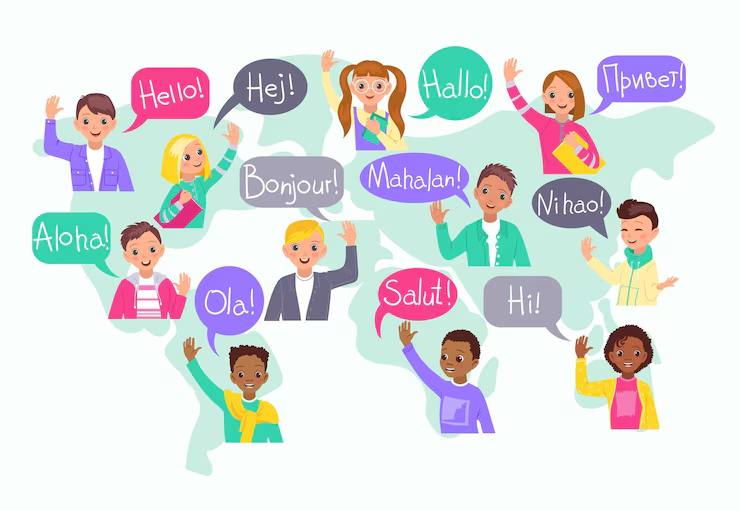
In today’s global world, speaking more than one language is a major advantage. Multilingual capabilities help individuals and businesses connect across cultures, access new markets, and build stronger relationships. Knowing different languages also improves brain function, memory, and problem-solving skills.
For businesses, being multilingual means reaching more customers. It helps companies understand different cultures, avoid misunderstandings, and build trust. In international markets, a local language can often make or break a deal.
On a personal level, speaking multiple languages opens up job opportunities. Employers value workers who can communicate with a wide range of clients and partners. Multilingual workers are often seen as adaptable and resourceful.
In education, learning languages sharpens the mind. Studies show bilingual people have better focus and multitasking skills. It also delays cognitive decline in older adults.
Multilingual Capabilities in Diplomacy: ASEAN Context
In diplomatic settings, especially within ASEAN, multilingual skills are critical. ASEAN is made up of diverse nations with different languages and cultures. Diplomats who can communicate in local languages foster stronger ties, smoother negotiations, and deeper mutual respect. Multilingualism helps bridge cultural gaps and promotes unity among member states, making regional cooperation more effective. Being able to speak the local language helps diplomats gain leverage, win hearts, and build lasting trust, all of which are vital for successful diplomacy.
Conclusion
In an increasingly interconnected world, multilingualism is not just a skill—it is a strategic asset. Whether in business, education, or diplomacy, the ability to communicate across languages creates opportunities for deeper engagement, stronger partnerships, and enhanced problem-solving. For individuals, it broadens career prospects and sharpens cognitive abilities. For businesses, it unlocks access to diverse markets and builds trust with global customers. In diplomacy, particularly within the multilingual ASEAN region, it fosters mutual respect, smooth negotiations, and more cohesive regional cooperation. Embracing multilingualism means embracing a world of opportunities—socially, professionally, and geopolitically.
References
American Council on the Teaching of Foreign Languages. (n.d.). Benefits of Language Learning. https://www.actfl.org/advocacy/what-the-research-shows
Forbes. (2017, December 6). Why Multilingual Employees Are More Valuable. https://www.forbes.com/sites/ashleystahl/2017/12/06/why-multilingual-employees-are-more-valuable/?sh=2f2eecf6594c
National Institutes of Health. (2012, February 27). Bilingualism delays onset of dementia, study suggests. https://www.nih.gov/news-events/news-releases/bilingualism-de